
SEO is not dead. It has changed.
For years, businesses treated SEO as a relatively straightforward formula:
Choose keywords → optimize pages → build links → rank on Google → get traffic.
That formula was never quite that simple, but it was a useful way to understand search engine optimization.
In 2026, however, search looks very different.
Google Search includes AI-powered experiences, users increasingly ask longer and more conversational questions, and businesses now have to think about visibility across traditional search results as well as AI-generated answers, images, videos, local results, and other search features.
So the obvious question is:
Is traditional SEO still working in 2026?
The answer is yes — but traditional SEO by itself is no longer enough.
Google’s own 2026 documentation says that SEO best practices continue to be relevant for appearing in its generative AI search features. Google has also published guidance specifically addressing AI Overviews, AI Mode, and optimization for generative AI features.
The future of SEO is therefore not about replacing traditional SEO with something completely different.
It is about building on the fundamentals while adapting to a much more complex search environment.
What Has Changed About SEO?
Before looking at what still works, it helps to understand what has changed.
Traditional search optimization focused heavily on getting a webpage to appear in a list of search results.
Today, a search journey can include:
- Traditional organic results
- AI-generated answers
- AI Overviews
- AI Mode
- Featured content
- Images
- Videos
- Local results
- Product results
- News
- Forums
- Other specialized search features
Google’s documentation has continued to evolve around these experiences. For example, AI Mode is now incorporated into Google’s documentation and Search Console reporting, while Google has added guidance about optimizing content for generative AI features.
This means your SEO strategy should no longer ask only:
“How do I rank #1?”
It should also ask:
“How can my business become visible and useful throughout the customer’s search journey?”
That is a much broader question.
1. Keywords Still Matter — But Search Intent Matters More
One of the biggest misconceptions about modern SEO is that keywords no longer matter.
They still do.
Search engines need to understand what a page is about.
If your business provides website design services, Google still needs to understand that your page is relevant to concepts such as:
- Website design
- Business website design
- Web development
- Website redesign
- Responsive websites
- Landing pages
But simply repeating those phrases throughout a page is not a good SEO strategy.
The bigger question is:
What does the person searching actually want?
Consider these searches:
Search A
“website design”
The user may simply want information.
Search B
“best website design company”
The user may be comparing providers.
Search C
“website design company for small business”
The user has a more specific commercial need.
Search D
“how much does a small business website cost”
The user is researching before making a decision.
The keyword is only part of the picture.
Intent provides the context.
2. Search Intent Is Becoming the Foundation of SEO
Modern SEO should begin with a question:
What problem is the searcher trying to solve?
Search intent is commonly grouped into categories such as:
- Informational
- Navigational
- Commercial
- Transactional
- Local
For example:
“What is SEO?”
→ Informational
“WebMart”
→ Navigational
“Best digital marketing agency for small businesses”
→ Commercial
“Hire a digital marketing agency”
→ Transactional
“Digital marketing agency near me”
→ Local
Each search represents a different stage of the customer journey.
A page that matches the searcher’s intent has a much better chance of being useful than a page created simply because a keyword has high search volume.
3. Helpful Content Is More Important Than Keyword Stuffing
There was a time when some SEO strategies focused heavily on keyword repetition.
For example:
“We are the best digital marketing company offering digital marketing services. Our digital marketing company provides digital marketing solutions…”
This may contain the target keyword repeatedly, but it doesn’t necessarily help the reader.
Modern SEO should focus on creating content that genuinely answers the user’s question.
Google’s current Search guidance emphasizes useful, reliable, people-first content rather than content created primarily to manipulate search rankings.
That changes how businesses should approach blogging.
Instead of writing:
“Digital Marketing Services”
over and over again, create an article such as:
“How Much Does Digital Marketing Cost for a Small Business?”
Then actually explain:
- What affects pricing
- What services are normally included
- How advertising budgets differ from agency fees
- What businesses should measure
- What a realistic starting strategy looks like
The keyword appears naturally because the topic requires it.
That is much stronger than forcing it into every paragraph.
4. AI Has Changed Search — But It Has Not Eliminated SEO
This is probably the biggest change in 2026.
AI-powered search experiences can synthesize information from multiple sources.
That means a customer may receive an AI-generated response instead of simply seeing a traditional list of links.
Some businesses therefore assume:
“If AI gives the answer, SEO is finished.”
That’s the wrong conclusion.
Google itself says its guidance for generative AI features builds on established SEO best practices.
In other words:
AI search still needs information.
And businesses still need to make their information accessible, understandable, useful, and trustworthy.
The question is becoming less about manipulating a ranking position and more about becoming a credible source that search systems can understand.
5 Geo Aeo Seo
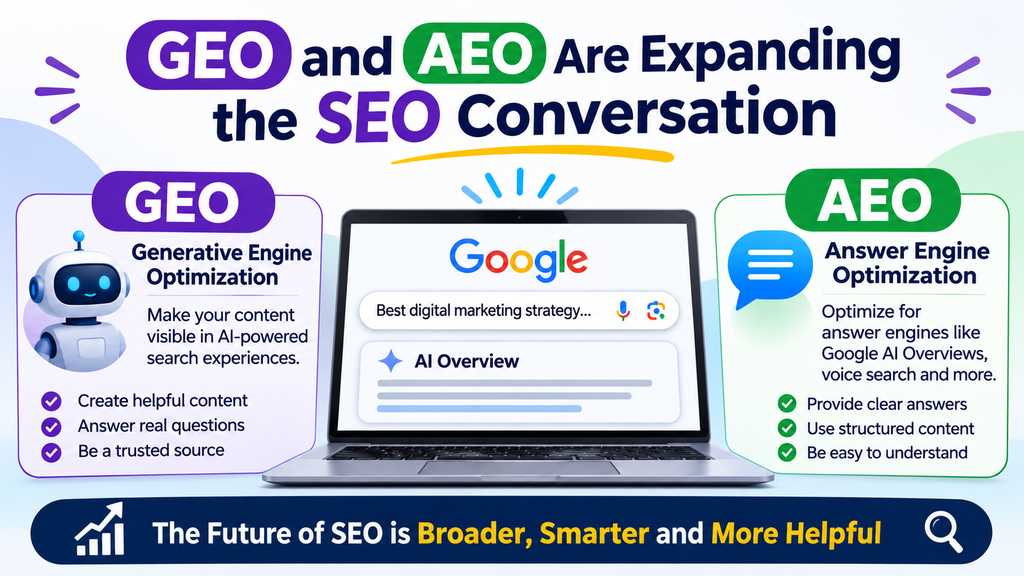
You may have heard terms such as:
- GEO — Generative Engine Optimization
- AEO — Answer Engine Optimization
- AI SEO
- AI Search Optimization
These terms describe different approaches to improving visibility in AI-driven and answer-oriented search experiences.
But businesses should be careful about treating them as magical replacements for SEO.
Google’s 2026 guidance specifically addresses misconceptions around AEO and GEO and explains why established SEO practices remain relevant for generative AI search features.
That means you don’t need to throw away your existing SEO strategy and start from zero.
Instead, strengthen the fundamentals.
Focus on:
- Clear content
- Useful answers
- Strong topical relevance
- Accurate information
- Original value
- Good site structure
- Crawlability
- Indexability
- Authoritative sources
- Good user experience
- Relevant internal linking
These foundations help both users and search systems understand your website.
6. Traditional On-Page SEO Still Works
Many traditional SEO techniques remain useful.
For example:
Page titles
Your title should clearly communicate what the page is about.

Headings
Use logical headings to organize information.
URLs
Create descriptive URLs that make sense to users.
Google’s current documentation recommends simple, descriptive URL structures and using readable words rather than confusing strings of numbers or parameters.
Internal links
Connect related pages so users and search engines can discover relevant content.
Image optimization
Use appropriate image formats, descriptive context, and useful alternative text where appropriate.
Meta descriptions
They don’t magically guarantee higher rankings, but they can help communicate what a page is about and influence how users understand the search result.
Structured data
Use supported structured data where it genuinely applies.
The key lesson is:
Traditional SEO has not disappeared.
It has become part of a larger system.
7. Technical SEO Still Matters
You can create the best article in the world, but technical problems can still make it difficult for search engines to access or understand your website.
Technical SEO includes areas such as:
- Crawlability
- Indexability
- Site architecture
- HTTPS
- Mobile usability
- Page experience
- Canonicalization
- Redirects
- XML sitemaps
- Robots.txt
- Structured data
- URL structure
- JavaScript handling
Google’s current documentation continues to maintain detailed guidance around crawling, indexing, robots controls, URLs, and search visibility.
This is important because the growth of AI search does not mean technical SEO becomes irrelevant.
If search engines cannot properly access your content, they have a harder time understanding it.
8. Content Depth Beats Content Volume
AI makes it easier than ever to produce large amounts of content.
That creates a problem.
If every business publishes 100 generic AI-generated articles, publishing more articles does not automatically create a competitive advantage.
Instead, businesses should ask:
What can we say that is genuinely useful or different?
Imagine two websites.
Website A
Publishes 500 generic articles.
Website B
Publishes 50 detailed articles based on:
- Real customer questions
- Original examples
- Industry experience
- Data
- Case studies
- Practical recommendations
- Expert insights
Website B may have a much stronger content strategy.
The goal should not be:
“How many articles can we publish?”
The better question is:
“How many important customer questions can we answer better than our competitors?”
9. Topical Authority Is Becoming More Important
Suppose you own a digital marketing agency.
You publish one article:
“What Is Digital Marketing?”
That’s useful, but it doesn’t establish much depth.
Now imagine your website has articles covering:
- What is digital marketing?
- SEO for small businesses
- Social media marketing
- Google Ads
- Website conversion optimization
- Email marketing
- Local SEO
- AI search
- GEO
- Content marketing
- Lead generation
- Marketing analytics
- Digital marketing ROI
- Marketing funnels
- Social media advertising
Now search engines can see a much broader relationship between your website and the topic of digital marketing.
This is the idea behind topical authority.
You are not simply targeting isolated keywords.
You are building a connected library of useful information.
10. Internal Linking Becomes a Strategic Tool
A blog should not be a collection of isolated articles.
Your content should connect.
For example:
Pillar article:
Digital Marketing for Small Businesses
could link to:
- SEO for Small Businesses
- Social Media Marketing Guide
- Website Design Guide
- Google Ads Guide
- Content Marketing Guide
- Local SEO Guide
Those articles can then link back to the pillar article.
This creates a logical content structure.
It also gives readers a clear path to learn more about your services and expertise.
For WebMart
A strong structure could look like:
Digital Marketing
↓
SEO
↓
SEO in 2026
↓
AI Search
↓
GEO
↓
SEO Services
This is much stronger than publishing random blog posts with no relationship between them.
11. Local SEO Still Matters
For businesses serving specific locations, local SEO remains extremely important.
Think about searches such as:
“digital marketing agency in Bengaluru”
or:
“web design company near me”
The customer isn’t looking for a worldwide resource.
They are looking for a business they can potentially work with.
Local SEO therefore involves areas such as:
- Google Business Profile
- Business information consistency
- Local landing pages
- Customer reviews
- Local relevance
- Location-specific content
- Citations where appropriate
- Website contact information
AI search doesn’t remove the need for local relevance.
If anything, businesses should make their location, services, and business information clearer.
12. Video SEO Is Part of Modern Search
SEO is no longer limited to written webpages.
People search through:
- YouTube
- TikTok
- Other social platforms
Businesses should therefore consider video as part of their search strategy.
For example, a web design company could create videos such as:
“5 signs your business website needs a redesign”
or:
“How much should a small business website cost?”
Those videos can potentially reach customers at different stages of the buying journey.
Google has also continued updating its video SEO documentation and guidance around video indexing.
13. Image SEO Is Still Relevant
Images are another part of modern search.
Businesses can optimize images through:
- Descriptive filenames
- Relevant surrounding content
- Appropriate alt text
- Good image quality
- Suitable formats
- Fast loading
- Proper metadata
For example, instead of an image filename like:
IMG_2847.jpg
a descriptive filename might be:
digital-marketing-services-webmart.jpg
The filename alone will not transform your SEO.
But clear image context contributes to a more understandable website.
Google has also updated its image SEO documentation, including guidance around preferred images and image metadata.
14. E-E-A-T Still Matters
You may have heard the term E-E-A-T.
It stands for:
Experience
Expertise
Authoritativeness
Trustworthiness
The important thing is that E-E-A-T is not simply a button you can switch on.
It should be reflected in your content and website.
For example, if you are writing about digital marketing:
Don’t simply publish generic definitions.
Show:
- Practical examples
- Real observations
- Author information
- Relevant experience
- Clear sources
- Case studies
- Original insights
- Transparent business information
If your business claims to specialize in something, demonstrate that expertise.
Don’t just tell people you’re an expert. Show them.
15. Brand SEO Is Becoming More Important
SEO used to be heavily focused on generic keywords.
But branded searches matter too.
Imagine someone first discovers WebMart through an article.
Later they search:
“WebMart digital marketing”
That branded search represents a stronger connection than an anonymous keyword search.
Businesses should therefore build recognizable brands alongside search traffic.
This means maintaining consistency across:
- Website
- Social media
- Google Business Profile
- YouTube
- Business directories
- Reviews
- Content
- Visual identity
The long-term goal isn’t simply to rank for keywords.
It is to become a brand people remember.
16. Don’t Ignore Search Console
If you are serious about SEO, you need to understand what is happening on your website.
Google Search Console can help businesses understand search performance.
You can examine information such as:
- Search queries
- Impressions
- Clicks
- Click-through rate
- Search traffic
- Indexing issues
- Search appearance
- Website performance
Google’s current documentation also notes that AI Mode is included in Search Console’s Performance reporting.
That makes measurement increasingly important as search becomes more diverse.
Instead of guessing what customers are searching for, businesses can use real search data to improve their content strategy.
17. Don’t Chase Every SEO Trend
This may be the most important lesson in this entire article.
SEO changes constantly.
One year it’s:
“Use this tag.”
Another year it’s:
“Create this type of content.”
Then:
“AI has killed SEO.”
Then:
“SEO is dead.”
Then:
“GEO has replaced SEO.”
Businesses can waste enormous amounts of time chasing every new claim.
A better strategy is to distinguish between:
Fundamentals
and
Trends
Fundamentals include:
- Useful content
- Search intent
- Good website structure
- Crawlability
- Relevant pages
- Clear information
- Good user experience
- Authority
- Trust
- Measurement
Trends include:
- New AI features
- New search interfaces
- New optimization terminology
- New content formats
- New platforms
Trends matter.
But fundamentals should form the foundation.
Traditional SEO vs SEO in 2026
| Traditional SEO | SEO in 2026 |
|---|---|
| Keywords | Keywords + intent |
| Website rankings | Search visibility across multiple experiences |
| Text content | Text + video + images + other content |
| Backlinks | Authority + relevance + reputation |
| Search results | Search + AI experiences |
| Website traffic | Qualified traffic + conversions |
| Blog publishing | Topic-focused content ecosystems |
| Google optimization | Multi-platform discovery |
| Ranking position | Visibility and business outcomes |
| SEO alone | SEO + brand + content + conversion |
The biggest difference is not that the old principles have disappeared.
It is that the environment around them has expanded.
What SEO Should Look Like for a Business in 2026
A modern SEO strategy should include at least these areas:
1. Technical SEO
Make your website accessible, crawlable, and indexable.
2. Keyword Research
Understand what people search for.
3. Search Intent
Understand why they search.
4. Helpful Content
Answer their questions properly.
5. Topical Authority
Build depth around important subjects.
6. On-Page SEO
Optimize titles, headings, URLs, images, links, and page content.
7. Local SEO
Improve visibility for location-based searches.
8. Video & Visual Search
Create content beyond traditional blog posts.
9. AI Search Visibility
Make your information clear, useful, authoritative, and easy for search systems to understand.
10. Conversion Optimization
Turn search visitors into leads and customers.
11. Measurement
Use Search Console, analytics, and business data to understand results.
12. Brand Building
Create a business people remember and search for directly.
A Practical SEO Checklist for 2026
Use this as a starting point.
Website
- Is your website mobile-friendly?
- Does it load efficiently?
- Can search engines crawl important pages?
- Are important pages indexable?
- Are your URLs descriptive?
- Is your site structure logical?
- Are important pages linked internally?
Content
- Does each page have a clear purpose?
- Does it satisfy search intent?
- Is it genuinely useful?
- Does it provide original value?
- Does it demonstrate expertise?
- Does it answer real customer questions?
AI Search
- Is your information clear?
- Are your key business facts easy to understand?
- Do you provide authoritative, non-generic content?
- Are you following Google’s current Search guidance?
- Are you avoiding spammy AI-generated content?
Local SEO
- Is your business information accurate?
- Is your Google Business Profile maintained?
- Are you collecting legitimate customer reviews?
- Do your website and local listings provide consistent information?
Measurement
- Are you using Search Console?
- Are you tracking organic traffic?
- Are you monitoring conversions?
- Are you identifying successful pages?
- Are you improving pages that underperform?
The Biggest SEO Mistakes to Avoid in 2026
Mistake 1: Publishing AI content without editing
AI can accelerate content production.
But publishing generic output without fact-checking, editing, or adding original value can create weak content.
Use AI as an assistant, not as your entire content strategy.
Mistake 2: Obsessing over keyword density
There is no magic percentage of times a keyword needs to appear.
Write naturally.
Cover the topic thoroughly.
Use relevant language.
Mistake 3: Creating content only for search engines
If your article is difficult to read, repetitive, or unhelpful, ranking alone won’t create a successful business.
Write for people first.
Mistake 4: Ignoring technical SEO
Beautiful content cannot compensate for a website that search engines cannot properly access or understand.
Mistake 5: Measuring only rankings
A keyword ranking is useful.
But the real business questions are:
Did traffic increase?
Did qualified leads increase?
Did sales increase?
Did customer acquisition become more efficient?
Mistake 6: Treating SEO as a one-time project
SEO is not:
“Optimize the website once and forget it.”
Search behavior changes.
Competitors publish new content.
Your business changes.
Search engines change.
Your SEO strategy should therefore be reviewed and improved continuously.
So, Is Traditional SEO Still Working in 2026?
Yes.
But the better question is:
Is traditional SEO alone enough in 2026?
Probably not.
The strongest approach is to keep the fundamentals and expand the strategy.
Traditional SEO gives you the foundation.
AI search adds a new layer.
Video adds another.
Social discovery adds another.
Local search adds another.
Brand building adds another.
Conversion optimization connects everything to business results.
Think of it this way:
Old SEO:
Keywords → Rankings → Traffic
Modern SEO:
Search Intent
↓
Useful Content
↓
Technical Foundation
↓
Search Visibility
↓
AI + Search + Social + Local Discovery
↓
Trust
↓
Conversions
↓
Business Growth
That is the real evolution of SEO.
Final Thoughts
SEO isn’t dead.
Low-quality SEO is.
Keyword stuffing is becoming less useful.
Mass-produced generic content is becoming less valuable.
Chasing every algorithm rumor is a poor strategy.
But useful content, strong websites, technical accessibility, search intent, authority, trust, and a clear understanding of customers remain extremely important.
Google’s own 2026 documentation reinforces this point: SEO best practices continue to matter for visibility in its generative AI search features, even as search experiences evolve.
So businesses should not abandon SEO.
They should modernize it.
In 2026, SEO is no longer simply about trying to put a webpage at the top of a list.
It is about helping your business become discoverable, understandable, credible, and useful wherever customers search.
And that is a much bigger opportunity than traditional SEO ever was.
Ready to Modernize Your SEO Strategy?
At WebMart, we help businesses strengthen their digital presence through website design, SEO, graphic design, social media marketing, and digital marketing services.
If your business is still relying on an old SEO strategy, 2026 is a good time to review what is working, identify what has changed, and build a search strategy designed for the modern customer journey.
WebMart — helping businesses get found, build trust, and grow online.
SEO Details
SEO Title: SEO in 2026: Is Traditional SEO Still Working?
Meta Description: Is traditional SEO still working in 2026? Learn how SEO is changing with AI search, AI Overviews, GEO, search intent, helpful content, local SEO, and modern search strategies.
Suggested URL: /seo-in-2026-is-traditional-seo-still-working
Primary Keyword: SEO in 2026
Secondary Keywords:
- traditional SEO in 2026
- is SEO still working
- SEO trends 2026
- AI SEO
- AI search optimization
- GEO
- generative engine optimization
- Google AI search
- SEO strategy 2026
- SEO for small businesses
- modern SEO strategy
Suggested Internal Links:
- Digital Marketing Trends Every Business Should Know in 2026
- What Is GEO (Generative Engine Optimization)?
- How to Optimize Your Business for AI Search
- Digital Marketing for Small Businesses
- How to Build a High-Converting Business Website
- Social Media Marketing for Small Businesses